
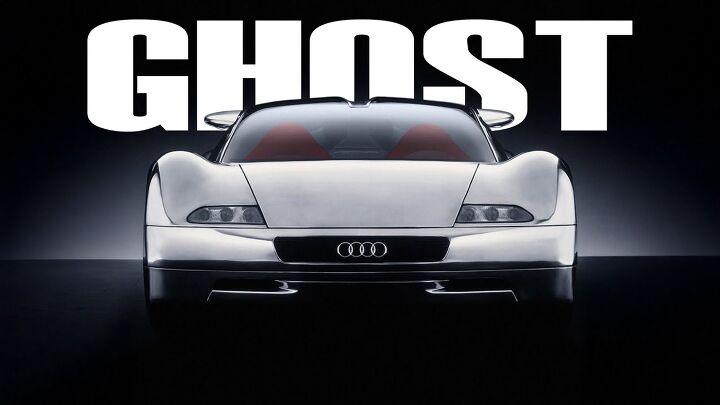

Every car company has at least one ghost in the cupboard. A machine that should have been, could have been, but never was. For Audi, that ghost is the Avus Quattro.
Unveiled at the 1991 Tokyo Motor Show, it was Audi at its most daring. A mid-engined, aluminium-bodied missile with a W12 engine, quattro all-wheel drive, and looks that made everything else at the show look like farm equipment. It was futuristic, outrageous, and yet—annoyingly—it wasn’t real. At least Not in the way most people had imagined. The Avus Quattro was a design study, a show car, a piece of rolling sculpture meant to announce that Audi had entered the 1990s with serious intent. And while it never reached production, its fingerprints are all over Audi’s later success stories.
The TTAC Creators Series tells stories and amplifies creators from all corners of the car world, including culture, dealerships, collections, modified builds and more.
A transcript, cleaned up via AI and edited by a staffer, is below.
[Image: YouTube Screenshot]
Become a TTAC insider. Get the latest news, features, TTAC takes, and everything else that gets to the truth about cars first by subscribing to our newsletter.
Transcript:
Every car company has at least one “ghost in the cupboard,” a machine that should have been, could have been, but never was. For Audi, that ghost is the Avus Quattro. Unveiled at the 1991 Tokyo Motor Show, it was one of the brand’s boldest concepts: a mid-engined aluminum-bodied show car with a W12 engine, all-wheel drive, and styling that made most of the show floor look dated by comparison. It was futuristic and outrageous, but it wasn’t real in the way many people assumed. The Avus was a design study—a rolling sculpture meant to signal that Audi was entering the 1990s with ambition. Although it never reached production, its influence can be traced through several later Audi models.
First impressions mattered, and the Avus’ bodywork drew immediate attention. The entire car was built from hand-formed aluminum, polished to a mirror finish. It looked less like a car and more like something from a Stanley Kubrick set. That effect was intentional. Audi’s designers were referencing the Auto Union Silver Arrows of the 1930s, the pre-war racers that once lapped Berlin’s AVUS circuit at extreme speeds. The concept also previewed Audi’s upcoming focus on aluminum construction. Three years later, the 1994 A8 arrived with the brand’s aluminum space-frame technology, a direct evolution of the ideas shown on the Avus. The concept itself, however, relied on a steel-tube skeleton beneath the bodywork. It was visually impressive but not structurally advanced. Audi claimed a weight of 1,250 kg, which was light for a car with supercar proportions, though the accuracy of that figure is debatable.
If the polished body didn’t get your attention, the wheels did. At 20 inches, they were enormous for the era. They filled the arches completely and exaggerated the car’s low, wide stance. From some angles, it barely looked like it had suspension travel at all. It was more architectural object than functional vehicle, designed to be observed rather than driven.
Behind the cockpit sat what Audi described as a 6-liter W12 engine producing 509 horsepower, paired with all-wheel drive and a six-speed manual transmission. The claimed performance—0–100 km/h in three seconds and a top speed above 340 km/h—would have made the Avus one of the fastest cars in the world at the time. But the engine was not functional. Most sources agree the W12 did not exist in any operable form in 1991. The unit installed in the Avus was a display model made from wood and plastic. Volkswagen would eventually develop a real W12 a decade later for the Phaeton and Bentley Continental GT, but in 1991, it was purely a concept. The Avus was a promise, not a prototype.
Inside, the car continued the futuristic theme with two bucket seats in red leather, a minimalist dashboard, and aviation-inspired controls. Unlike many concept interiors of the era, it avoided gimmicks. It looked purposeful and almost production-ready in its simplicity.
At the Tokyo Motor Show, the Avus overshadowed much of the competition. Japanese manufacturers were demonstrating new engineering ideas—Nissan with the Mid4, Toyota with early hybrid concepts—but Audi arrived with a polished aluminum supercar and made an immediate impression. It signaled a shift in the brand’s identity, moving from Volkswagen’s conservative sibling to a brand capable of competing with established sports-car makers.
While the Avus never moved beyond its concept stage, it wasn’t without impact. The Quattro Spyder, shown the same year, further mapped out Audi’s vision for a mid-engine sports car. That vision finally materialized in 2006 with the Audi R8. The Avus’ influence is visible in the R8’s stance, aluminum construction, and mix of racing heritage and modern aesthetics. Without the Avus, the R8 likely wouldn’t have taken the form it did.
As for why Audi never built it, the reasons were straightforward. The early 1990s were not an ideal environment for launching an expensive supercar due to a global recession. Audi also lacked the resources at the time to develop a mid-engine aluminum W12 supercar from scratch. More importantly, the Avus was never intended for production. It was a statement piece, created to inspire rather than to sell.
Today, the Avus Quattro sits in Audi’s museum. It still attracts attention, and its design hasn’t aged poorly. If anything, it looks more contemporary than many early-1990s concepts. Its clean lines, polished finish, and oversized wheels make it feel timeless, a reminder of an era when automakers used concept cars to provoke imagination before regulations and budgets limited what could be shown.
The original video ends by asking viewers what they think of the car and its story and encourages them to like and subscribe.
[Music]
