
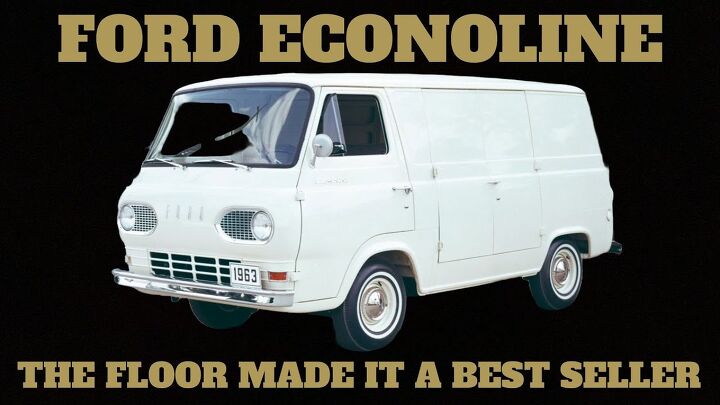

The 1961 Econoline Van and Ford Club Wagon and Cab over pickup when introduced were going to change the way everyone in the industry built a van.
Development began in 1957 and it was to replace the F-series Panel delivery.
Click through on the video to see how the way Ford influenced change.
For more Ford related content subscribe here: https://www.youtube.com/c/TonysFordsa…
The TTAC Creators Series tells stories and amplifies creators from all corners of the car world, including culture, dealerships, collections, modified builds and more.
A transcript, created by AI and edited by a staffer, is below.
[Image: Tony’s Fords and Mustangs/YouTube]
Become a TTAC insider. Get the latest news, features, TTAC takes, and everything else that gets to the truth about cars first by subscribing to our newsletter.
Transcript:
The 1961 Econoline van, Club Wagon, and cabover pickup changed how the industry approached van design. Development began in 1957, and the lineup was created to replace the Ford F-Series panel delivery. The Econoline entered the market against the VW Transporter and the soon-to-arrive Chevrolet Corvair 95.
On paper, Ford seemed to be at a disadvantage. Both the Chevy and VW used rear-mounted, air-cooled engines. The Corvair had near 50/50 weight distribution and independent rear suspension. By comparison, the Econoline used a mid-mounted—really more front-mounted—engine, resulting in a 60/40 weight split. That made traction in rain or snow more challenging. But the Econoline had one major advantage: a low, flat rear floor. Anyone who has loaded a cargo van knows how valuable that is. This video takes a closer look at the first-generation Econoline and answers how much that low floor really mattered.
Vintage Ford commercial audio
A new shape, a new design, with a new name: Ford Econoline.
The Econoline pickup offered four main advantages: a lower price—up to $239 less than standard half-ton trucks—better fuel economy with up to 30 mpg in certified tests, lower weight thanks to 1,050 pounds less chassis mass, and more load space with a 7-foot box and up to 23% more capacity in a truck that was three feet shorter.
The Econoline van shared the same economy features and offered 204 cubic feet of cargo space, with access from the rear or curb side. Ford also offered the Econoline Station Bus, which cost less than most compact wagons and had twice the interior space of the biggest full-size wagons. It could convert to a cargo hauler quickly.
Released in September 1960 as a 1961 model, the Econoline came as a cargo van, passenger wagon, Deluxe Club Wagon, or cab-forward pickup. It used the Falcon platform with a unibody design, a solid rear axle, an I-beam front axle, and variable-rate leaf springs front and rear. Drum brakes were fitted all around, and the vans rolled on 6.5×14-inch bias-ply tires.
The design was simple. A flat front end held the windshield and headlamps with aluminum bezels. Lower on the body were the engine air inlet and wraparound turn signals. The doors sat fully forward, their lower edges arched to clear the front wheel openings. Cargo and passenger vans had barn doors on the passenger side. Passenger vans also had three side windows plus a fixed triangular window behind the front seats. Rear barn doors had fixed windows and round recessed tail lamps. The cabover pickup used rolled beltline edges to form the bed, with rounded cab corners and a fixed rear window. All corners of the Econoline were rounded, including the roofline.
Power came from either an 85-hp 144-ci inline-six or an optional 101-hp 170-ci inline-six, which produced 156 lb-ft of torque. Both engines paired with a three-speed manual shifted from the steering column.
Standard equipment was minimal: electric wipers, a rearview mirror, bumpers, turn signals, and padded dual front seats on vans and pickups. The Station Bus added a full-length headliner, interior trim panels, chrome latches, coat hooks, a dome light, carpeting, a driver’s visor, and wheel caps. The Deluxe Club Wagon included additional exterior trim, a nicer interior, and the larger 170-ci engine as standard. Options included a heater, sun visors, emergency flashers, inside mirror, dual horns, cigarette lighter, hubcaps, chrome bumpers, a dome light, and a radio.
Ford advertised the Econoline as 1,050 pounds lighter than the outgoing panel van but capable of hauling up to 1,650 pounds. The pickup had a 7-foot bed; the van carried 204 cubic feet of cargo; and the Station Wagon seated up to eight people. The shorter overall length made parking and tight-space maneuvering much easier. Ford also claimed up to 30 mpg in certified testing.
Buyers responded well. Ford sold 61,135 Econolines for 1961. The 1962 models carried over unchanged, and sales rose to 76,938.
The 1963 models received a fully synchronized three-speed transmission, optional driver-side barn doors, a retractable step, and larger 7×14-inch wheels and tires that increased GVW to 4,350 pounds. Sales continued climbing, reaching 88,053.
For 1964, Ford introduced a lower-priced panel van without side doors, and added a four-speed manual and Cruise-O-Matic automatic to the options list. The pickup gained optional quarter windows. The Deluxe Club Wagon added available camping gear such as a compact kitchen with a folding shelf, stove, table, and storage, or a folding mattress for two. Ford remained the segment sales leader, delivering 83,079 units.
In 1965, the four-speed manual was dropped, and Ford introduced a new 150-hp 240-ci inline-six. The 170-ci engine became standard. The Super Van debuted, adding 18 inches of cargo length—enough to load 4×8 sheets of plywood or drywall with the doors closed. Ford sold 76,867 Econolines for 1965.
The 1966 lineup saw no meaningful changes, but sales rose again to 84,180. The 1967 models also carried over as Ford prepared for a redesigned van. A UAW strike delayed the launch, and the new Econoline didn’t appear until January 1968. Ford sold 81,752 units during the extended 1967 model year, which became the last for the cabover pickup.
Returning to the question at the beginning: that low rear floor made a significant difference. It made loading easier front to back and allowed a forklift to place a 40×48-inch skid inside—something neither the VW van nor the Corvair 95 could do. The Corvair 95 ended production after 1965, with only 1,500 units sold that year.
Ford originally expected the pickup to outsell the van, but the opposite happened. Vans outsold pickups 9 to 1, leading to the pickup’s cancellation. Chevrolet and Dodge released similar cabover vans in 1964—noticeable similarities to the Econoline. The second-generation 1969 Econoline moved the engine even farther forward and offered a V8 for the first time, but that’s another topic entirely.
If you enjoyed the video, consider liking and subscribing. The channel now has more than 250 videos covering Ford, Lincoln, and Mercury. Thanks for watching.
